Mrs M is moving!
January 4, 2015 § Leave a comment
After much deliberation, I have decided to leave this digital home for a new nest. From now on you can find Mrs M’s musings and experiments at Mrs M’s Curiosity Cabinet.

Thank you to everybody who has followed my antics here, whether an occasional reader or a regular visitor. Thanks also for leaving comments, starting discussions, challenging my ideas… I hope you will continue to follow my adventures in curiosity at the new home.
Please pop over to the new page for my thinking behind my new haunt, and sign up for regular updates. There are various technical options to keep track of my wanderings, so I hope you will find one that suits you.
This site will stay active for some time but all past posts (and your lovely comments) have moved too so the whole anthology will stay together.
2014: a very satisfactory year
December 31, 2014 § 13 Comments
It’s true: time really does seem to move faster the older you get. It seems like only five minutes ago that I was readying myself for 2014 and now 2015 is upon us.
As I survey the past twelve months, it feels like it has been an important year, maybe even a turning point. There were precious few major upheavals and no once-in-a-lifetime adventures but amongst the seemingly ordinary ebb and flow of daily life, I spot significant milestones, the confluence of experience, skills and ideas, appropriate endings and exciting beginnings.
The year started with a new job, one I resigned from before the first quarter was out. To the Mrs M of five years ago, this would have seemed like madness. I would have stuck with it for eighteen months or a year as that would have been the ‘sensible’ thing to do or it would have looked okay on the CV. But to me, quitting a job that made my heart sink within a month of starting felt utterly right. By resigning I was putting myself first rather than perpetuating old, destructive habits of putting an employer’s, organisation’s and clients’ wishes ahead of what was good for me. It, of course, also meant I had to trust in my value and potential and that too felt like a major breakthrough.
If 2014 started with working out what I most definitely didn’t want, most of the year revolved around pursuing and nurturing the treasures I do want in my life: the relationships, skills, soul food,… In a nutshell, 2014 was the year:
- I became an auntie, a doting and eccentric one just as I have always wanted to be. Whilst my niece’s arrival has not triggered any desire to have children of my own, I am smitten with her. I am also enjoying getting to know my siblings in their guise of parent, uncle and aunt and love having carte blanche to spend a lot of time in the children’s section of bookshops;
- I learnt one of the oldest crafts known to man, pottery. To my delight, and slight amazement, I not only discovered I love this most traditional of skills, but that despite my arthritic hands, I am quite good at drawing vessels out of clay. Don’t even get me started on my fascination with the chemistry of glazes…;

One of my simple hand-thrown bowls, part of a little homage to my father
- I started to pitch my writing for publication, resulting in a feature article in print, mentioned in passing here, and more glowingly here and here by a couple of lovely bloggers. (Note to self: I must increase self-promotion efforts in 2015, no matter how icky it feels). I also, in an “oh-sod-it” moment, decided to turn an idea into a book proposal and have started to submit it for consideration. Having written one book proposal, ideas for others are already bubbling away in my brain;
- I shared many a conversations with like-minded souls, both online and off, who like me are trying to make sense of our relationship with each other and the material world and the contradiction of abundance and impoverishment in our society. Some discussions reassured me I was not going quietly mad on my own and fed a sense of solidarity and collective effort. Others led to encounters when I happened to be in the same city, like a delightful evening in Edinburgh with The Inelegant Horserider just days before the Scottish Referendum, or to the exchange of tips on cooking, growing, dyeing, sewing… with curious souls from the US to Sweden;
- I embraced knitting small items. Constrained by clothes rationing and arthritis on the one hand and spurred on by the arrival of my niece, the constructive defiance in a post about knitting your own hand towels and a thoroughly generous gift of yarn on the other, I focussed on small pieces in 2014: baby clothes, flannels, socks, mittens…; and
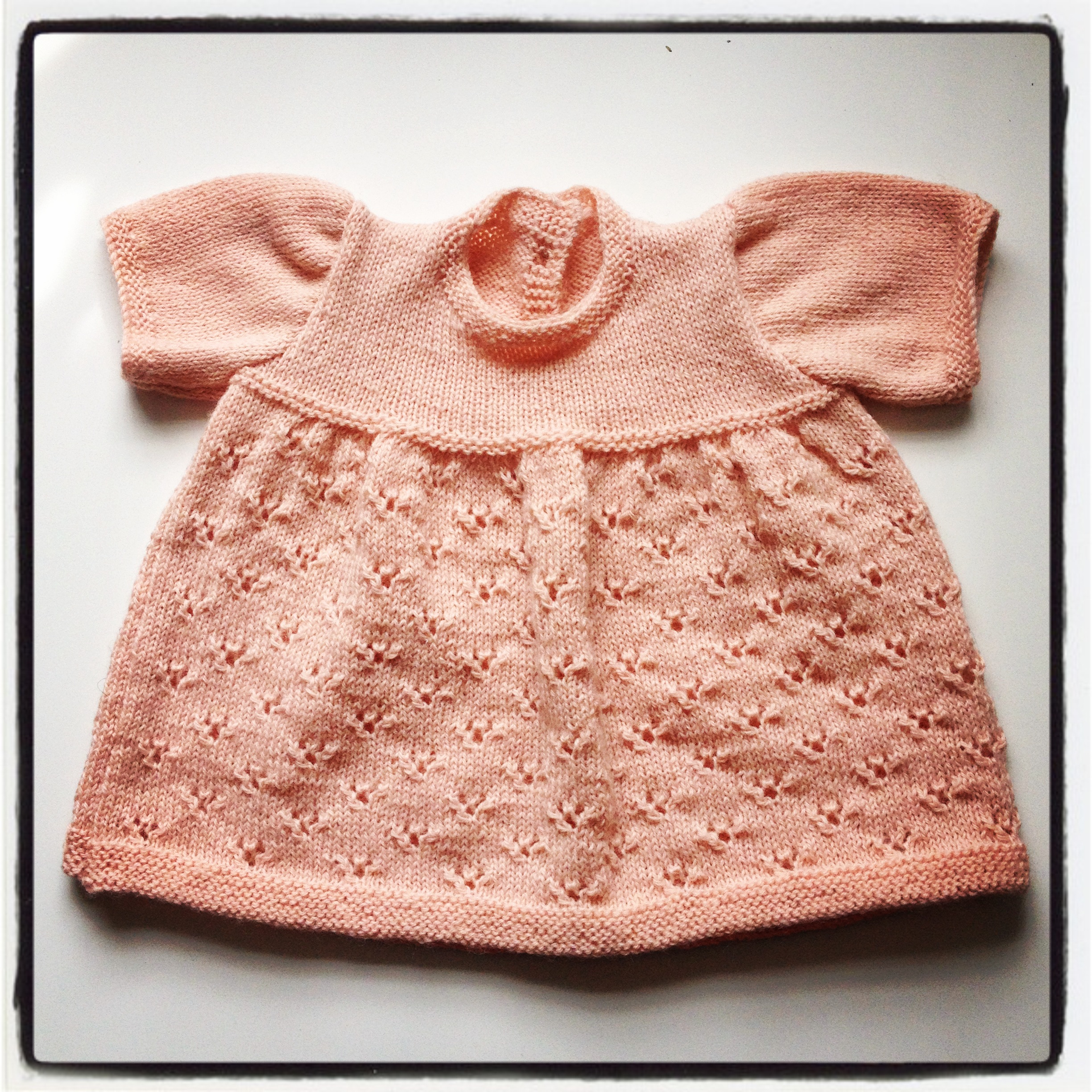
Knitting for the wee one
- I stopped fighting my body, even if this meant letting go of longstanding habits that were interwoven with my identity (e.g. the heat seeking tea addict) and of social expectations (goodbye vino and hair dye!), or embracing the eccentricity of writing or playing the violin in fingerless mittens (like some character from Austen or Dickens who has fallen on hard times). Turning 40 may have given me the confidence to care (even) less about norms and conventions than before but deciding to direct my time, finite energy and physical strength to those things that are truly meaningful to me is intrinsically tied up with my interest in sustainability.
In a similar vein, 2014 was the year I took creating what I wish existed to a new level, prompting me to ‘pounce’ on chance remarks made by likeminded individuals with the suggestion we turn this ‘thinking aloud’ into reality. Sowing such ideas is much like sowing seeds. Some fall on rocky ground, some drift off with the wind, some fall prey to the weeds of busy lives… Occasionally, though, one falls into fertile soil and with the right gardeners to tend it, the seed takes root, not necessarily into the seedling we expect but into something beautiful with the potential to nourish those who enjoy its fruit. I am currently fertilising and training just such a seedling together with Wendy (of Roof Top Veg Plot), a fellow writer, gardener and thinker, so keep your eyes out for an exciting new venture in 2015, one based around words, ideas and nurturing!
Panic Saturday? Hardly…
December 23, 2014 § 2 Comments
Apparently it was Panic Saturday last weekend. I’m not sure who thinks up these names. Is it the media desperate for a headline or retailers eager to persuade us to spend more before stores close for a whole 24 hours over Christmas? Needless to say, there was not a hint of panic in my dealings on Saturday.
As we are blessed with excellent independent shops in Greenwich, Mr M and I strolled out to do our normal weekend grocery shopping. The queues outside the butcher were a little longer than normal but perfectly calm. The cheesemonger and grocery shop were doing brisk trade, as usual, but not so brisk that there wasn’t time to taste a new variety of cheese or exchange a little banter with Jason in the greengrocer’s. After completing most of our shopping we briefly stopped in the Co-op to stock up on olive oil, toilet roll & aluminium foil for the ‘duration’ before wandering home calmly.
The rest of the day I busied myself in a relaxed fashion with some food preparation, correspondence and a spot of knitting.
Serene in the kitchen
There is no denying that Christmas is only a few days away. As we are not entertaining any children over Christmas, we probably have an easier ride than most. There are a few traditional dishes and special treats but we don’t go over the top on the food front. I draw up a balanced menu for the Christmas week, just as I do any other week of the year, spreading out not only the meat, fish and vegetarian meals but also the rich dishes and sweet treats.
On Saturday, whilst others were panicking in retail venues, I rustled up some adult candied peel, as well as my normal weekend loaf and a batch of cinnamon biscuits. Making candied peel is very simple: it involves citrus peel, in my case orange peel, and a sugar syrup.
Accounts of the water to sugar to peel ratio vary widely as does the drying times. The lovely Lucy of Food, wine and other pleasures makes a particularly luscious version but it takes days to dry. As my tooth is not so sweet, I opt for less sugar (roughly equal parts sugar to peel) and less liquid. The result is a touch of sweetness and a good hint of sherbet due to the fruit’s acidity, the bitterness of the pith and the generous dash of Cointreau. Using less syrup means the candied peel is dry in about 36 hours and ready to dip in dark chocolate.
It may be time for a little Christmas indulgence but that’s no excuse for wastefulness. I therefore juiced the oranges before peeling them and boiled the juice up with the orange pith, the squeezed flesh and a couple of pints of water (including the liquid left over from boiling the orange peel) into a light orange juice. This became the basis for one of Mr M’s favourite desserts: orange & Cointreau jelly*. As pith is naturally high in pectin, my thriftiness saved me about of a third of the gelatine needed when using commercial orange juice! This frugal approach also means the dessert is a little lighter and not cloyingly sweet.
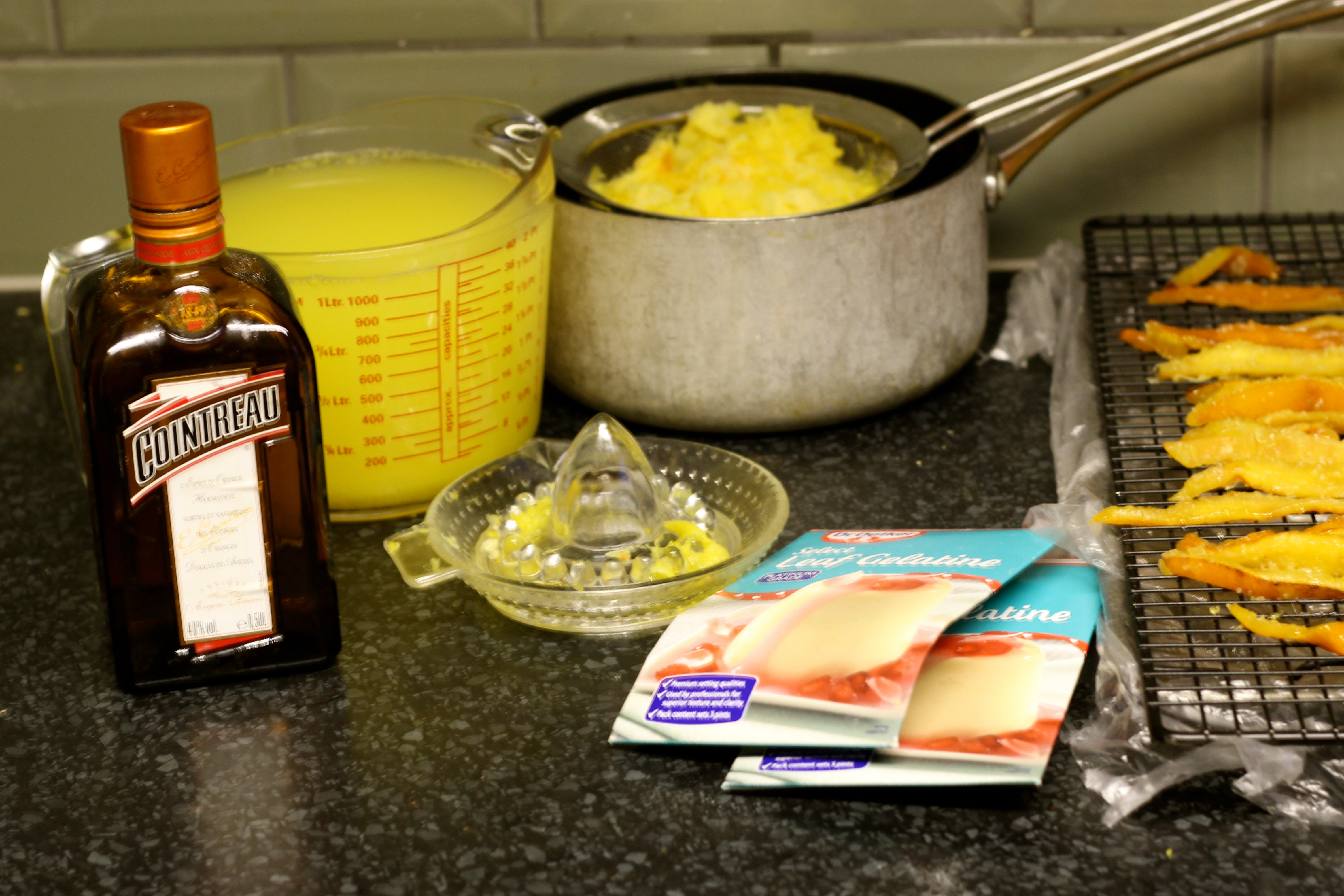
Luxurious, waste-free treats in the making

Orange & Cointreau treats in two guises
Leisurely productivity
Having made a start on the Christmas treats, I then settled down with a little old-school correspondence.
I have a bit of a hit-and-miss attitude to writing seasons greetings. I suppose my approach to greeting cards is pretty much like my approach to gifts. I believe in generosity – if anything the world needs more of it – and I love giving presents but I don’t really see the need to pin them to Christmas (or birthdays for that matter). Sometimes friends and family receive gifts at Christmas, sometimes on their birthday but mostly just when I spot something that I know will delight them.
So it goes with cards. I send some Christmas cards and some hand-penned letters. Not a round-robin epistle but a carefully considered letter or a note in an attractive card that isn’t necessarily seasonal. So on Saturday afternoon I got out the Basildon Bond and my calligraphy pen and enjoyed myself for a couple of hours writing letters to friends in far-flung places.

The ultimate in slow mail
Then I turned my attention to a spot of knitting. I took a break from the various gifts I am making because there is no reason why they can’t be a New Year’s Day gift or a cheerful late January present, just as the winter hits its cold, dark post-Christmas depths. I switched the wireless on and relaxed with my cardigan project: a very simple, classic woollen cardigan using Excelana, one of my favourite British yarns. As one programme drifted into another, the left front grew. When I finally put down my knitting to start supper, I could hear the telltale sounds of rush hour: heavy traffic and urgent horns, probably from frazzled people who had braved the shops. I wondered whether their Saturday had been as enjoyable as mine…?
***
* Jello rather than jam to my North American readers (although I have been known to make orange & Cointreau marmalade too before now).
Several rounds with the demons
December 17, 2014 § 3 Comments
It has been an exhausting few months. Productive, definitely, but physically and emotionally draining. I recently submitted two key proposals; one academic and one literary. It has been thoroughly draining but something interesting happened when I finally sent off the submissions.
Kernels of ideas
Getting to the submit button involves work of course, a lot of work. Some of it is visible and obviously industrious but much is invisible, occurring only in the neurological passages of the senses and the cogs of the mind.
The first phase barely looks like work at all. There are the months of conscious living, senses permanently alert, the observing, registering and reading, the filing away of shards of information and impressions… Notebooks and archiving software come into play to some extent but mostly snippets just disappear into the complex circuitry of my mind. With time, continuous feeding and patience the data is processed. Hints of a hypothesis and hazy concepts emerge. Yes, they will require further research and refining but ideas firmly set up camp in my mind and, with them, the certainty they are worth exploring further.
At this point the conscious research starts and before long I’m surrounded by articles, newspaper snippets, book chapters… with key thoughts highlighted and ideas scribbled in the margins. Notebooks fill up with a few lines of a thought, penned hastily before it evaporates like a will-o’-the-whisp. A file appears on my hard drive with pages of disconnected passages and paragraphs that capture half-moulded opinions and hunches.
The demons circle
Before long these fragments morph into unwritten theories or ideas. At this point it is essential I start writing, not the finished product, but paragraphs that capture the essence of the idea and where it might take me. These paragraphs, which start the process of turning mental meanderings into a piece of work and form the basis of a proposal, are however some of the toughest to get down. Even if the data has percolated into a robust idea, even if I am determined to turn it into something substantial, even though I love the act of writing, fear of the blank page pops up. I know full well that once I have written the first few paragraphs, I will be away but I procrastinate by reading yet another article or checking another source.
Procrastination is completely normal. New students to published authors and almost everyone in between seem to experience it in some form. Suddenly anything and everything is more appealing than tackling that blank page: ironing Mr M’s shirts, scrubbing the bathroom, doing my tax return…
Driven by the determined idea that has implanted itself in my brain (and often an external deadline too), I finally write the first lines. The opening paragraphs of my proposal gradually take shape. Before long the sentences are flowing out and I hit the recommended word or page count in the submission guidelines, which brings me to the next big hurdle: editing the first draft.
Squaring up to the demons
If fear keeps me from the blank page, dread stalls the read-through of the rough first draft. Dread that I have written complete and utter rubbish. Dread that ideas that seemed worthy and cogent in my head have fizzled into insignificance on the page. I know from experience, from all the press releases and contracts to the blog posts and academic essays I have ever drafted, that once I start editing, I will thoroughly enjoy the process. It is one of the most annoying contradictions. Mrs M the wordsmith loves the métier of using words and syntax to refine and clarify thoughts; Mrs M the originator of ideas is petrified of revisiting the first draft!
After much cajoling and procrastination the wordsmith wins but not before the demons have landed a few punches. The second, third and however many more re-drafts are not nearly as painful. The wordsmith in me is in full flow by then but therein lies a danger too.
Revising and editing can be a tactic to avoid the next hurdle: handing the work over to somebody else. Just as I am satisfied that the draft is as good as it will ever be and I open the email or electronic form to submit it, the enemy within truly rears its ugly head. Bruised from the previous rounds but determined, it throws out all the insinuations it has been held back; it taunts me with old insecurities; and it pounces on past ghosts, memories of which still have the power to unsettle.
At this point the only thing to do is give the demons a resounding punch in the stomach and hit ‘submit’ but it takes energy and self-belief and leaves me feeling drained. However, stunned by my own boldness, I also feel oddly invigorated and am aware of a small but important window. Staring out those measly bastards gives me a shot in the arm. The pesky sods will be back before long but whilst they are still wondering what hit them, I can use the adrenaline surge to get to work on the next project, to tackle my next blank page…
Since hitting the submit button, I have started work on a few more projects that have been in the pipeline for some time. There will be some changes around here, some new ventures in 2015… and hopefully a slightly smaller, slightly weaker cohort of demons to pester me.
Further reflections on needs and wants
December 10, 2014 § 2 Comments

I’ve written before about how rationing forces me to distinguish between needs and wants but as the second year of my clothes rationing experiment draws to a close, I am gaining new perspectives on both.
Waning wants
I have not bought a skirt (or pair of trousers for that matter) in over four years. I could quite easily justify a new one. As I’ve been wearing my two staples pretty much continuously for the last few years, they will probably need replacing before too long. The denim skirt may struggle on for another year before the seams perish; my black corduroy one will hopefully last two more (if I get it relined).
Why have I not modestly splashed out on a new skirt or pair of trousers for so long? Is it due to the rationing? In a way, yes, but not in the coupon counting sense. I have not bought a new one of either as I simply haven’t seen anything that I liked enough to tempt me, so why waste coupons?
Mulling it over, I’ve realised that rationing has not necessarily dissolved the desire for certain garments but it has certainly eroded my longing for most of the currently available incarnations. In many ways, this clothing experiment has changed my baseline. Much like I have lost the taste for nuts and ice cream due to lethal allergy and a mild intolerance, the desire for many colours, shapes, fabric… has evaporated entirely.
Rethinking needs
If wants are fading, where do I stand on needs? Obviously, in its narrowest meaning, needs cover the clothes on my back and a change of clothes in the wardrobe but that extreme was never the intention of wartime rationing and neither is it mine. I’m thinking of needs in terms of enough to be pleasantly comfortable.
So how am I getting on with balancing my needs with rationing, particularly as stock starts to wear out. This year, quite a few undergarments, socks and stockings have given up the ghost as elastic has perished or darns have worn through again. More items are threatening to go the same way. The leather on my long winter boots is perilously thin; there’s the denim skirt that’s on its last legs; and my black trousers are clinging on thanks to some strategically placed iron-on fabric.
On that basis, I can definitely justify some new undies, a skirt or pair of trousers and new boots. Despite this list of ‘needs’ I have actually struggled to spend all my coupons this year, not least of all because I can’t find any staples that I like enough to consider, let alone that pass muster in terms of quality, environmental and ethical considerations.
I suspect my wartime peers did not have the luxury of being this picky about style and colour due the level of shortages and the likelihood of the coupon allowance being slashed in subsequent years – by 1945 resources were so short that it had shrunk to a paltry 24 coupons! With such constraints, I imagine people thought of all purchases as essential stock (rather than in terms of needs or wants), stocking up when they could and making do with colours and shapes that may not have been their first choice before the war.
Although I am still fussy about the shape and colours of my outerwear (even though it really should not be a problem to find a classic pair of side-zipped wide legged black trousers!), I too increasingly regard clothes shopping as sensible acts of stock replenishment, with a bit of frivolity once in a blue moon. Quite a healthy view and a very satisfactory outcome from two years of rationing!
This ‘information’ film is unconnected to this post but I’m quite amused at the lengths wartime ladies could go to make the most of one dress. I suspect the tailored cut helps!
###
Coupon update
So what have I actually spent coupons on in recent months? Restocking accounted for most of my remaining purchases: undies (4 coupons), leggings that function as tights (2 coupons), cosy homemade socks (1 coupon), a sensible, dark, warm cardigan (still on my knitting needles but accounting for 5 coupons).
A new scarf/shawl accounts for a further two. This is unashamedly an indulgence as I have several already but due to my chilly disposition and its warmth and ability to transform wardrobe staples, it is one I have no qualms about allowing myself.
Total coupons spent in 2014: 56.5 coupons
So with only a few more weeks of the year left, I still have 9.5 coupons, enough for a pair of trousers – should I spot those elusive classics – and a bra or a pair of boots – if I find any that I like and are comfortable -, a bra and another pair of socks.
I also managed to avoid purchases by my ongoing make do and mend efforts – or make, do and mend, as Jackie, a fellow ‘rationee’, has redubbed it. Darning the darns on two pairs of socks saved two coupons and a T-shirt from a charity shop a further five. I’m also working on a pair of multi-coloured stripey fingertip-less gloves, using up odds and ends of skeins (2 coupons). They’ll hardly be the height of elegance but they’re only intended for use around the house to keep my hands warm whilst I work on the computer.
Total coupons saved by making, doing and mending: 22.5 coupons






 The Double Life of Mrs M